
Faces of innovation: Nora Colson
Behind every breakthrough is a dedicated researcher pushing the boundaries of knowledge. In our Faces of Innovation series, we put the spotlight on our PhD students as they reach the home stretch of their research. With her doctoral defense right around the corner, meet Nora Colson!
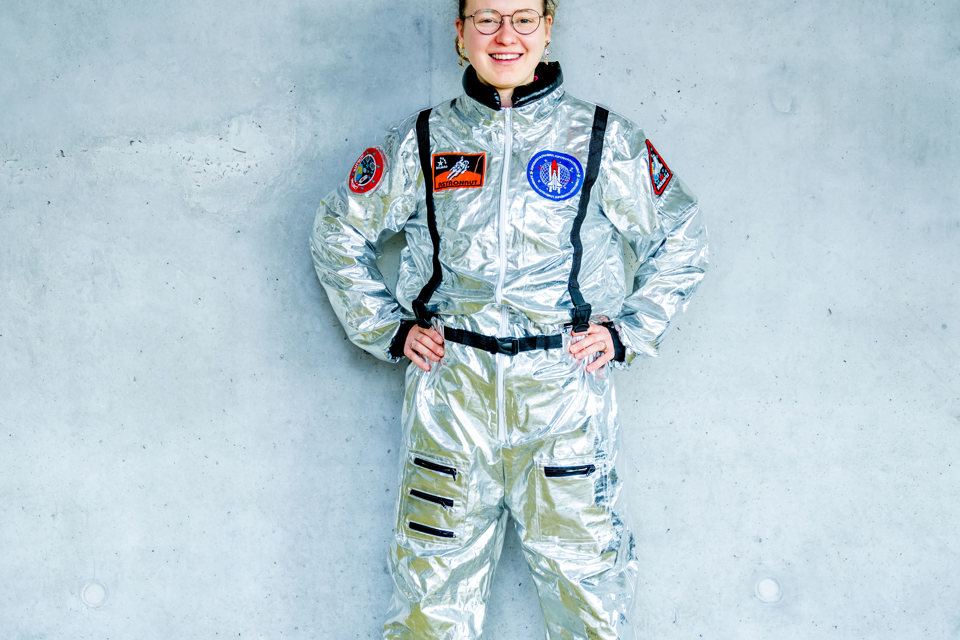
How do you explain your PhD defense to an outsider?
"During future missions to the Moon or Mars, astronauts will need systems that continuously recycle essential resources. Cyanobacteria, microscopic organisms that use sunlight to grow, are interesting for this purpose because they absorb carbon dioxide and produce oxygen and biomass.
In my PhD, I investigated whether the space-relevant cyanobacterium Limnospira indica could take on an additional role: generating an electrical current when exposed to light. I tried to connect these living organisms to an electrode made from boron-doped diamond, an exceptionally stable material.
The main challenge was getting the biological and synthetic components to work together. The cyanobacteria did not naturally attach well to the diamond, so I developed a thin, mussel-inspired polydopamine layer that holds them close to the electrode while preserving their activity. This bio-hybrid electrode produced an enhanced light-dependent current. Although it is still an early-stage concept, it represents a first step towards living, light-driven technologies for regenerative systems in space."
IUMAT takes a highly interdisciplinary approach. How has this changed your perspective on materials technology?
"My PhD brought together materials science, biology, electrochemistry, photosynthesis research and space technology. It was conducted within IUMAT, in collaboration with SCK CEN and Empa (Switzerland). Each partner brought different expertise to the project, from diamond electrodes and material characterization to cyanobacteria, irradiation studies, and photoelectrochemistry.
This collaboration taught me that a material cannot be judged by its individual properties alone. Boron-doped diamond is stable, conductive and chemically robust, but that did not automatically make it a suitable surface for living cyanobacteria. The decisive factor was the interface connecting both components. Even the shape of the cyanobacterial filaments affected the electrode’s performance.
I now see materials technology as the design of an entire system rather than the selection of one material. Some of the most interesting discoveries emerge when people from different disciplines and institutions examine the same problem from different perspectives."
EUREKA moment: what was the absolute highlight of the past few years?
"My EUREKA moment began with a conversation at a summer school organized by the European Society for Photobiology. I was looking for a way to attach cyanobacteria firmly to a diamond electrode without harming the cells or preventing electron transfer. Massimo Trotta, from CNR Bari, suggested that I investigate polydopamine, a mussel-inspired material known for adhering to many different surfaces.
That suggestion became a turning point in my PhD. Polydopamine formed a thin, biocompatible layer that anchored the cyanobacteria to the diamond while preserving their photoelectrochemical activity. Seeing that this approach not only worked but also enhanced the generated photocurrent was the real EUREKA moment. It demonstrated how one conversation outside your immediate field can redirect an entire research project and lead to its central result."
Where do you hope your research will be in 7 years? What impact will this have on everyday life?
"In seven years, I hope this research will have progressed from an experimental bio-hybrid electrode towards a complete and durable device. The next steps include improving the polydopamine interface, understanding precisely how the cyanobacteria transfer electrons, maintaining their performance over longer periods, and ultimately demonstrating the production of a useful fuel such as hydrogen.
In the longer term, cyanobacteria could become part of multifunctional regenerative systems that recycle carbon dioxide, produce oxygen and biomass, and harvest light-driven electrons. This would be especially valuable during long space missions, where resources are limited and resupply from Earth is difficult.
The principles explored in this research are also relevant on Earth. Combining living organisms with robust materials could contribute to sustainable technologies for carbon dioxide recycling, resource recovery, and solar-energy conversion. Space provides an extreme testing ground, but the knowledge developed for space can ultimately help us create more circular and resource-efficient technologies here on Earth.
Finally, I would also like to acknowledge that this research was made possible through the support of the Research Foundation – Flanders (FWO) and the European Space Agency (ESA), and through the contributions of the collaborations with SCK CEN, and Empa."
On Monday, 26 October 2026, Nora her doctoral defense will take place. Eager to learn more about her research?
- Monday, 26 October 2026 03.00 p.m
- Begijnhof, Huis 2, room H2 1.04, Campus Hasselt